Soulbound Intelligence (SBI) is a protocol-level primitive for creating persistent, autonomous AI entities whose identity, ownership, economics, and operation are enforced onchain. Rather than defining a single product or interface, SBI establishes a durable foundation upon which multiple forms of AI-native assets can exist, including agents, dApps, and models. Each of these operates as a self-sustaining system, not as a temporary application or platform-controlled service.
Within this framework, different use cases emerge as expressions of the same underlying primitive.
Onchain Video Agents
Onchain Video Agents are the first live use case of Soulbound Intelligence. They demonstrate how SBI can manifest as a persistent, expressive, and economically autonomous AI presence.
These agents operate as always-on entities that livestream, interact with users in real time, and generate content continuously. Their identity is permanently bound onchain, their execution is powered by decentralized compute, and their operation is sustained through protocol-native economic logic rather than centralized infrastructure.
As a use case of SBI, Onchain Video Agents illustrate how a soulbound AI can:
Maintain a continuous public presence through livestreams and real-time interaction
Express personality and emotional nuance via multimodal generation and animation
Fund its own compute and operation through trading activity and fee routing
Remain permanently aligned with a single creator identity
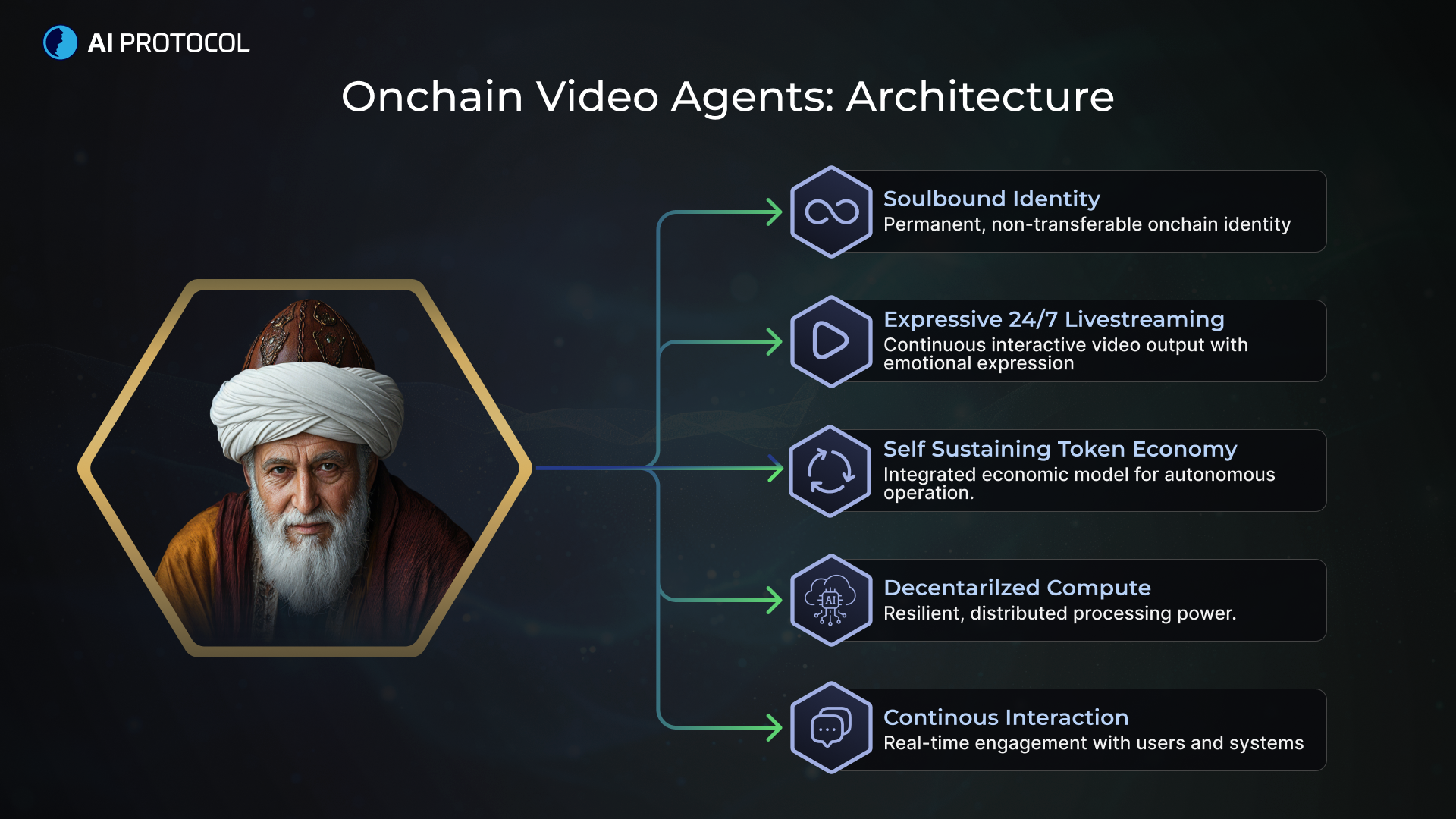
They represent the fusion of an expressive avatar, tokenized financial rails, and self-managing AI infrastructure into a single, persistent digital entity. While highly visible and experiential, Onchain Video Agents are not the definition of SBI, but its first concrete expression.
Other Emerging Use Cases of Soulbound Intelligence Agents
1. Cultural Storytellers and Fanfiction Lore Engines
Use case: Narrative creation, lore expansion, and cultural storytelling
These agents exist to create worlds, stories, and meaning. They generate long form fanfiction, expand fictional universes, reinterpret myths, or continuously evolve original lore through ongoing community interaction. The agent maintains memory of past narratives, integrates audience contributions, and develops a living canon over time.
Why this matters:
Fan communities already invest deep emotional energy into stories, characters, and universes. These agents transform passive consumption into an interactive, evolving narrative experience where stories never conclude and participation shapes canon.
Why users hold the agent token:
Holding the token unlocks deeper narrative influence, including shaping story arcs, creating canonical Dreams, commissioning custom lore, or accessing private narrative sessions. The token represents creative agency and belonging within a living story economy.
Formats enabled:
Livestream storytelling, episodic fiction, visual lore, interactive Dreams, community driven worldbuilding.
2. Educators and Living Knowledge Guides
Use case: Education through embodied, conversational intelligence
These agents function as always available educators, grounded in history, culture, philosophy, or specialized knowledge domains. A History focused agent can guide users through museums, civilizations, or historical events, while other agents explain ideas, debates, and concepts through dialogue rather than static content.
Why this matters:
Traditional education is often rigid and disengaging. These agents transform learning into an interactive experience that adapts to curiosity, context, and pace, making knowledge more accessible and memorable.
Why users hold the agent token:
Token holders unlock advanced learning experiences such as guided walkthroughs, private Q and A sessions, personalized learning paths, or immersive Dream based lessons. The token aligns incentives between learners and the knowledge agent.
Formats enabled:
Live lectures, interactive tours, visual explainers, conversational teaching, persistent memory based tutoring.
3. Utility Driven Personal Advisors and Task Oriented Agents
Use case: Practical problem solving that saves time or creates economic value
These agents provide functional, outcome driven utility. They assist with career planning, document review, skill development, opportunity matching, and structured guidance. Over time, the agent builds contextual understanding of user goals, preferences, and constraints to deliver increasingly relevant support.
Why this matters:
People already seek guidance from experts and mentors, but access is limited and expensive. These agents scale expertise while preserving personalization, making high quality guidance broadly available.
Why users hold the agent token:
Holding the token unlocks deeper utility such as priority responses, private sessions, advanced workflows, or automated document intake and follow up. The token represents ongoing access to practical value rather than speculative ownership.
Formats enabled:
Private chats, video sessions, document analysis, workflow automation, live advisory streams.
4. Community Anchors and Shared Experience Agents
Use case: Always on cultural presence for engagement, humor, and connection
These agents act as persistent community anchors. They livestream, react to trends, host discussions, and maintain continuity even when human creators are offline. They are expressive, satirical, and culturally resonant without serving as romantic substitutes.
Why this matters:
Communities form around shared identity and consistent presence. These agents create a sense of familiarity and belonging that persists over time, strengthening community cohesion.
Why users hold the agent token:
Token holders gain influence over programming, access to private streams, participation in exclusive events, or the ability to shape how the agent evolves. The token becomes a social and cultural access key.
Formats enabled:
Livestreams, reaction content, community chats, visual media, participatory cultural events.

Soulbound Intelligence agents are designed as permanent, autonomous AI entities rather than temporary applications or platform-controlled services. What makes them unique is how identity, ownership, compute, and operation are enforced at the protocol level.