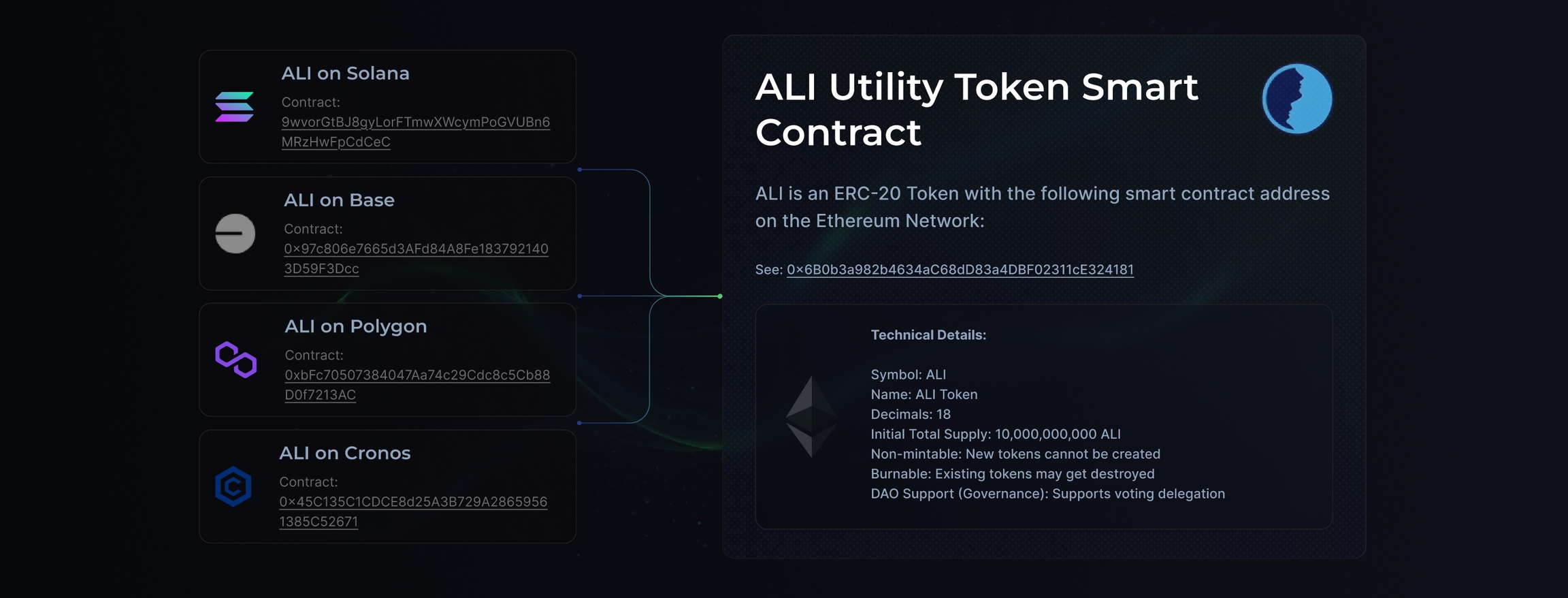
The native Artificial Liquid Intelligence (ALI) Utility Token is central to the AI Protocol’s decentralized operations, governance, and growth. Blockchain-agnostic and versatile, ALI facilitates asset creation, provides liquidity, supports staking and transactions, enables access to AI services, and powers governance and reward mechanisms within the ecosystem.
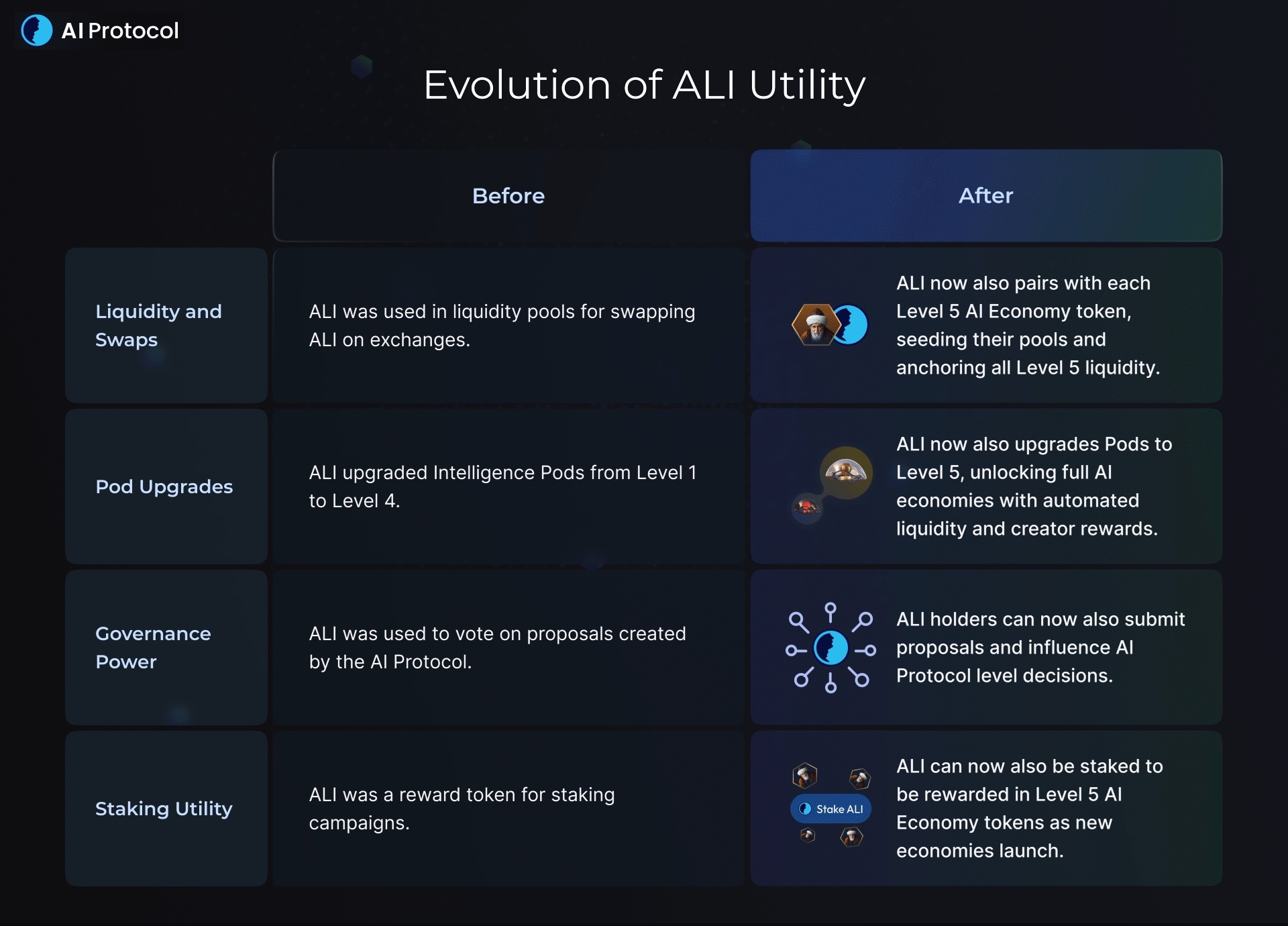
ALI regulates and incentivizes participation at the protocol level, enabling a decentralized intelligence economy driven by token-based network effects. Beyond serving as a means of transacting, ALI functions as an intelligence access primitive, seamlessly coordinating interactions among users, dApps, and AI assets.
Finally, ALI also functions as a reserve asset across the ecosystem, backing upgrades to Intelligence assets across the network. As the AI Protocol evolves into v3, ALI will serve as the unit of exchange for credits, agent services, and intelligent interactions across various dApps.
The native Artificial Liquid Intelligence (ALI) Utility Token is central to the AI Protocol’s decentralized operations, governance, and growth. Blockchain-agnostic and versatile, ALI facilitates asset creation, liquidity provisioning, staking, and transactions. It enables access to AI services, powers governance and reward mechanisms, and serves as a reserve asset backing upgrades to intelligence assets across the ecosystem.
ALI enables programmatic liquidity strategies that enhance the functionality of agents, models, and dApps. It fuels liquidity pools and incentivizes interactions, ensuring deep, stable liquidity for the continuous operation of the AI services provided by Onchain Video Agents, decentralized applications (dApps), and intelligent models. These market-making strategies ensure that ALI functions as both a transactional medium and an economic access primitive.
The tokenomics of ALI adapt to the diverse use cases across the ecosystem:
dApps: ALI enables seamless interactions between users and decentralized applications, powering access to services, governance features, and the consumption of computational resources within these applications. For example, a dApp might use ALI to pay for access to AI models or storage.
Agents: ALI supports the operational needs of AI agents, such as compute fees for services like live streams, chat interactions, and Dreams. It ensures the smooth operation of these agents by securing autonomous liquidity for their self-sustaining economies, allowing them to continuously operate without external intervention.
Models: ALI serves as the currency for AI model interactions, including training and inference tasks. For instance, a model might require ALI for running specific computations or accessing data, allowing AI-powered systems to scale more efficiently.

As the Protocol’s governance token, ALI empowers holders to vote on proposals via Snapshot.org, influencing decisions on service pricing, network evolution, and the future direction of intelligence within the ecosystem. The ALI Token is not just a transactional medium but a liquidity and governance backbone, providing stability and ensuring long-term sustainability for decentralized AI systems.
This framework allows ALI to seamlessly integrate with various assets in the AI Protocol, creating a cohesive, sustainable ecosystem driven by liquidity, compute, and governance.