Value Architecture in AI Ecosystems
The evolution of artificial intelligence is bifurcating into two distinct paradigms: closed-platform ecosystems (exemplified by OpenAI) and open-protocol ecosystems (represented by "AI Protocol").
Their core divergence lies in how value is created, captured, and distributed. While centralized platforms optimize for proprietary control and shareholder returns, decentralized protocols prioritize collective contribution, transparent ownership, and network-wide value sharing. This foundational difference reshapes innovation velocity, economic inclusivity, and long-term resilience.
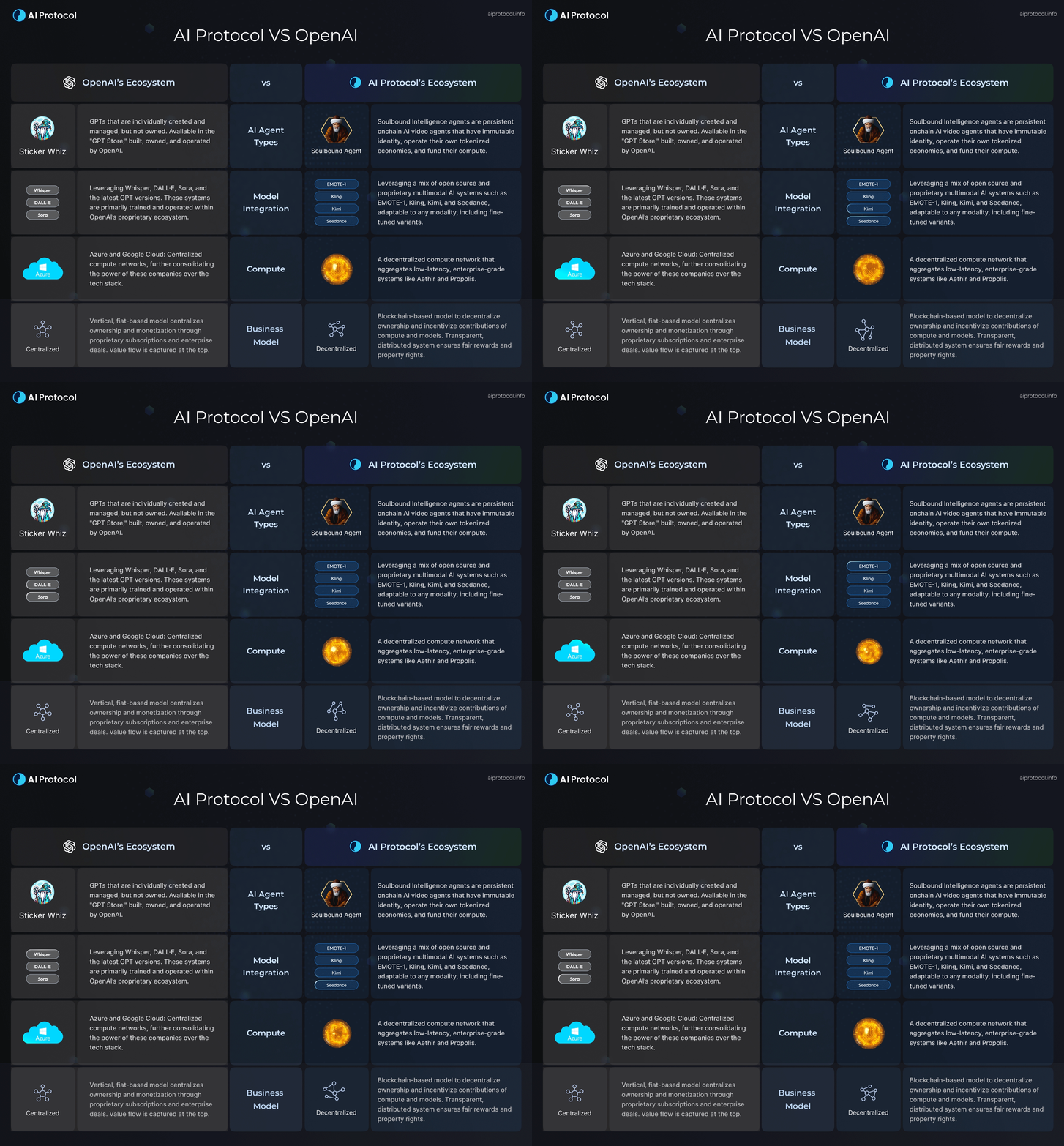
The AI Protocol reimagines artificial intelligence as a participant-owned ecosystem where creators, users, and developers co-create value through tokenized collaboration. Unlike traditional platform models, this architecture transforms passive consumers into active stakeholders. This aligns incentives via cryptographic primitives (tokens, INFTs, liquidity pools) and decentralizes value capture across the network. The result is a self-reinforcing economic flywheel where individual contributions compound into collective intelligence and shared rewards.
In this participant-owned AI ecosystem, creators act as architects by designing and deploying dynamic, reward-generating AI assets that evolve through use. Developers serve as ecosystem engineers, building interoperable dApps where these AI assets are deployed, collaborate, and be monetized. Users go beyond passive consumption to become co-creators, actively training agents, contributing data, and staking tokens to enhance network intelligence and liquidity.
Together, these roles form a synergistic triad where value creation, driven by asset evolution, dApp innovation, and participatory refinement, directly fuels distributed value capture, aligning incentives across the decentralized network.
Value Capture: The Tokenized Virtuous Cycle
The ALI Utility Token serves as the coordination & liquidity layer across the protocol's ecosystem, functioning as an access medium for staking mechanisms, liquidity pairings, dApp services and premium features, a rewards vehicle for asset deployment and participation, and a governance instrument, enabling fuller participant influence.
Creators capture value through tokenized incentives and swapping fees, generating regular rewards from their AI assets. Developers earn rewards via transaction and ecosystem activity fees. Users gain ownership in intelligence growth through governance mechanisms and staking. Liquidity pools ensure fair use value and their LP logic promotes long-term sustained commitment. Value accrues to holders through utility amplification, not extraction, sustaining a tokenized virtuous cycle.

AI Protocol Features
The AI Protocol is a comprehensive smart contract and intelligence framework designed to facilitate the development of the next generation of decentralized, AI-driven systems, services, applications, and assets.
The following five defining features distinguish the AI Protocol:
Decentralized Infrastructure
The AI Protocol is fundamentally constructed upon a decentralized infrastructure that obviates the necessity for centralized intermediaries. This architectural choice enhances security, resilience, and resistance to censorship, thereby providing a trustless environment that empowers users and developers in the deployment of agentic AI-driven solutions.
Soulbound Intelligence Economy Deployment
At the core of the Protocol is the ability to upgrade Intelligence Pods to Level 5 through the Genesis Launchpad. A Level 5 upgrade launches a Soulbound Intelligence economy that permanently fuses an AI agent with its onchain token system. These economies are non transferable and irreversible, ensuring that intelligence, identity, and economic activity remain bound together as a single long lived entity.
Integration of AI-Powered Decentralized Applications (dApps)
Developers are afforded the capability to build and deploy decentralized applications (dApps) on the AI Protocol. These applications leverage the protocol's combined blockchain and AI architecture to deliver novel, user-centric experiences, fostering new forms of value creation and promoting active participation and innovation within the ecosystem.
Tokenization of AI Assets
The AI Protocol enables creators to tokenize and deploy AI-based assets, including interactive AI Agents, Protocol-native dApps, as well as decentralized AI models and datasets, and anchor them in sustainable economies through Level 5 Intelligence Pods (L5 Pods). Unlike fragile, siloed launches on other platforms, L5 Pods guarantee deep, protocol-aligned liquidity at creation, ensuring that each Agent’s market is resilient, transparent, and interconnected with the broader ALI network. This design allows tokenized AI assets to thrive as sustainable micro-economies, capable of scaling with their communities, interoperating across chains, and reinforcing the long-term health and growth of the AI Protocol ecosystem.
The ALI Token as the Ecosystem’s Foundation
The ecosystem is underpinned by the Artificial Liquid Intelligence (ALI) Token, which functions as the primary governance, utility, and reward mechanism. The ALI Token serves to align the incentives of all participants, thereby supporting the creation, coordination, and evolution of AI-powered assets and decentralized systems within the protocol's network.

The Emergent Intelligence Flywheel
The AI Protocol's competitive advantage stems from a self-reinforcing cycle:
Phase 1: Creators deploy AI Assets that developers make accessible within dApps, driving user engagement and asset training.
Phase 2: User interactions trigger intelligence upgrades, evolving agents into higher-capability collaborative experiences.
Phase 3: Superior intelligence attracts more users, increasing demand for ALI tokens, deepening liquidity pools, and boosting the exchange value of fees and staking rewards.
Phase 4: Higher rewards then draw additional creators and developers, accelerating new asset and dApp creation.
This forms a robust and resilient ecosystem where network effects compound with participation while decentralized ownership distributes risk.