Why Soulbound Intelligence Is the Missing Primitive
The central challenge facing decentralized AI is not intelligence, scale, or coordination alone. It is the absence of a native economic primitive capable of sustaining autonomous AI systems over time. While onchain AI agents, dApps, and models have demonstrated remarkable advances in reasoning, expression, and adaptability, the economic foundations required to support them as long-lived systems have remained fragile.
Soulbound Intelligence (SBI) addresses this gap. It introduces a new class of AI-native infrastructure that binds intelligence, ownership, liquidity, and compute into a single, irreversible economic unit. Without such a primitive, AI assets remain structurally exposed to liquidity shocks, incentive misalignment, and operational dependency. With it, AI systems can operate as durable, self-sustaining participants in an open network.
Soulbound Intelligence (SBI) is emerging as the foundational missing primitive for sustainable decentralized AI agent economies. It functions as a persistent on-chain unit that fuses an agent’s identity, avatar, dApp logic, and AI model into a single composable entity. A Soulbound “intelligence” token permanently links the agent’s capabilities and credentials to one self-sovereign identity. By interweaving these facets, SBI provides an economic architecture that addresses systemic impediments in current agent ecosystems: it mitigates liquidity fragility in tokenized AI markets, secures funding for compute resources, and aligns incentives to prevent contributor burnout and under-provisioned upkeep. This enables AI agents to operate as durable, self-sustaining public goods with true economic and functional sovereignty. Each agent maintains its own on-chain identity and assets, evolves its model over time, and autonomously interacts within Web3 without reliance on centralized intermediaries
Systemic Impediments to Sustainable AI Agent Economies
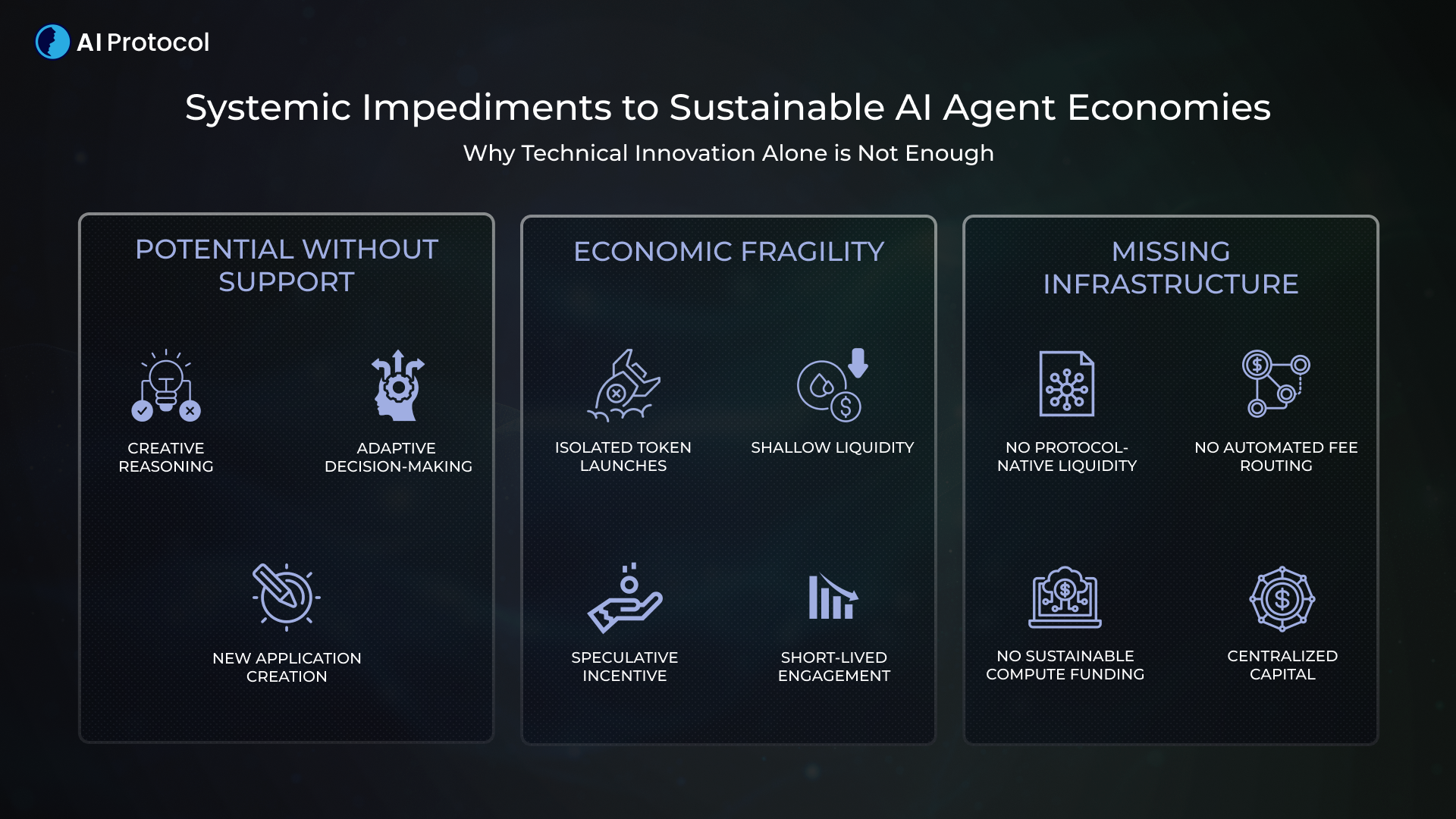
The failure of most tokenized AI projects is not driven by weak models or insufficient technical ambition. It is driven by systemic economic fragility. AI assets are typically launched as isolated tokens, disconnected from any broader liquidity substrate and unsupported by long-term operational funding.
Shallow or fragmented liquidity pools leave these assets vulnerable to volatility and speculation, undermining their ability to attract sustained community participation, developer investment, or ongoing compute resources. Incentive structures often prioritize short-term token emissions over durable value creation, resulting in rapid decay once initial momentum fades.
At the same time, compute and inference costs are treated as externalities rather than first-class economic considerations. Without embedded mechanisms to fund and coordinate compute over time, even technically capable AI systems struggle to remain operational. These combined pressures cause many agent-based projects to collapse shortly after launch, not because intelligence fails, but because the surrounding economic system cannot support it.
This instability represents one of the primary barriers to the long-term viability of decentralized AI economies.
The Missing Infrastructure for Sustainable AI Economies
The challenge facing decentralized AI ecosystems extends beyond coordination or governance. It lies in the absence of an integrated economic infrastructure that supports capital formation, liquidity durability, incentive alignment, and compute funding as a unified system.
Most existing frameworks rely on extractive or transient economic models, centralized capital injections, or platform-controlled infrastructure. These approaches fail to support the continuous evolution of intelligent systems and concentrate innovation among a small number of well-capitalized actors. The majority of creators and assets are left without access to sustainable liquidity, scalable compute, or aligned long-term incentives.
Without protocol-native mechanisms for liquidity provisioning, fee routing, and operational funding, AI assets cannot maintain enduring onchain economies. The lack of integrated financial and computational architecture has prevented intelligence from becoming a durable, composable public good.
The Solution: Soulbound Intelligence Economies
The AI Protocol addresses this fundamental problem through the introduction of Soulbound Intelligence (SBI), via Level 5 Intelligence Pods, a core innovation that provides the missing foundation for sustainable, interoperable, and liquid AI economies.

The Level 5 Intelligence Pod is a protocol-native infrastructure unit that fuses with an AI asset, such as an agent, dApp, model, or dataset, and transforms it into a self-sustaining, tokenized Soulbound Intelligence economy. Each Pod is engineered to launch with guaranteed liquidity and long-term operational stability, eliminating the fragility that characterizes isolated token projects.
Every Level 5 Pod requires a 20M ALI commitment to upgrade, which in turn deploys 10 million ALI for liquidity and reserves 10 million ALI for operational, market-making, and reward resources. This ensures that every AI asset deployed through the Protocol begins its lifecycle with inherent stability, fortified liquidity, and integration into a shared financial and computational network.
Through this endeavor, the Level 5 Pod enables every asset to participate in a unified, ALI-anchored liquidity ecosystem rather than existing as a disconnected or speculative token. The result is a network of interoperable AI economies, each contributing to the liquidity depth, intelligence capacity, and economic resilience of the AI Protocol.
Core Features of Level 5 Intelligence Pods
Level 5 Intelligence Pods connect AI assets to the AI Protocol’s integrated economic, technical, and community infrastructure. This includes automated liquidity provisioning, fee distribution mechanisms, and access to decentralized compute orchestration, ensuring that intelligence remains operational and funded over time.

In parallel, each Pod unlocks multimodal capabilities for real-time, high-fidelity expressive interaction, along with protocol-native discovery, analytics, and community participation tools. These systems enable creators and contributors to track performance, scale engagement, and transparently understand how value flows through each economy.
The Soulbound Intelligence framework applies uniformly across agents, dApps, models, and datasets, providing each asset class with the liquidity, operational support, and incentive alignment required for long-term economic health.
A Unified Framework for Decentralized Intelligence
By embedding sustainability directly into the infrastructure layer, the AI Protocol replaces short-lived, speculative AI projects with an enduring network of interoperable intelligence economies. Each deployed asset strengthens the system by expanding shared liquidity and computational capacity, making the network more resilient as it grows.
dApps and models within the ecosystem further reinforce this loop by offering specialized datasets, inference access, and token-based incentives that attract Soulbound Intelligence economies to operate within protocol-native environments. This creates a multi-layer feedback system where intelligence, liquidity, compute, and community growth reinforce one another.
Through the introduction of Soulbound Intelligence economies, the AI Protocol establishes the first scalable standard for sustainable AI economies. What emerges is a system where intelligence is not only powerful, but durable. It becomes both emergently expressive and economically sovereign. Every new Soulbound Intelligence asset strengthens the collective future of the whole of the protocol, and therefore, all it supports.
The AI Protocol v3 transcends providing the foundational lattice for dynamic and sustainable tokenized AI asset innovation.
It defines the standard.